
Pool Fence Requirements for Sarasota Homes
What Florida's pool barrier law requires, how it plays out in Sarasota and Manatee, and how we build pool fences that pass inspection.
Florida's Pool Barrier Law
Florida's Residential Swimming Pool Safety Act (Chapter 515, Florida Statutes) requires new residential pools to have at least one approved safety feature, and a pool barrier is the most common. Under F.S. 515.29, the barrier must:
- Be at least 4 ft high on the outside.
- Have no gaps, openings, indentations or protrusions that let a young child crawl under, squeeze through or climb over.
- Surround the pool, separate from any yard fence unless that fence sits on the pool perimeter and meets the rules.
- Sit far enough from the water's edge that a child who gets through can't fall straight in.
Gates
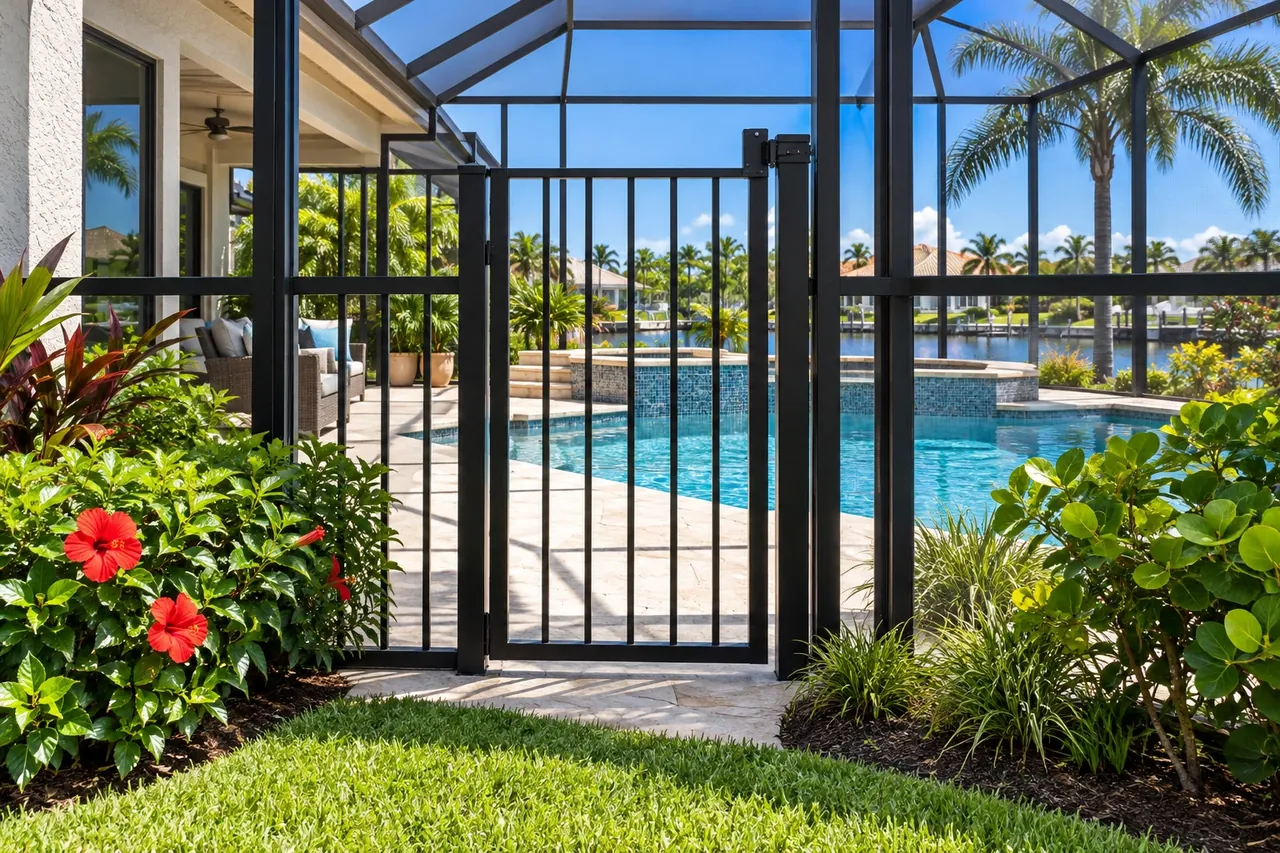
Pool gates must open outward, away from the pool, and be self-closing and self-latching. The latch release goes on the pool side, placed so a young child can't reach it over the top or through a gap.
How It Works Locally
- Unincorporated Sarasota County: an aluminum pool fence needs a building permit, since only wood, vinyl and chain link are exempt.
- City of Sarasota and Venice: city rules and inspections apply. We coordinate with the building department.
- North Port: fences 6 ft or shorter on one- and two-family lots skip the building permit, but the barrier still has to meet state law.
- New pools: if the fence serves as the barrier for a pool under construction, we coordinate with your pool builder.
Best Materials
- Aluminum: rust-free, see-through and the easiest to build to spacing rules.
- Vinyl: privacy around the deck, built without footholds on the outside.
- Chain link: possible with small enough mesh, mostly on budget projects.
Every pool fence we build gets a self-closing, self-latching gate that swings away from the water.
Where Pool Fences Go Wrong
- A gate that swings toward the pool or doesn't close from every position.
- A latch low enough for a small child to reach.
- Too big a gap under the fence where the yard dips or a swale runs through.
- An AC unit, planter or bench outside the fence that works as a step.
- Horizontal rails on the outside that act like a ladder.
We check for all of these before the inspector does.
Keeping It Compliant
A pool fence only protects if the gate still closes and latches. Salt air and sprinkler spray wear on hinges and latches, so test the gate every month: open it partway, let go and make sure it shuts and catches on its own. If it doesn't, call us for a gate repair.
Frequently Asked Questions
How tall must a pool fence be in Florida?
At least 4 ft measured on the outside.
Does a pool gate have to close by itself?
Yes. It must open outward away from the pool and be self-closing and self-latching.
Which material is best for a pool fence?
Aluminum, because it meets the spacing rules easily, doesn't rust and keeps the pool visible from the house.
Can my yard fence be the pool barrier?
Only if it sits on the pool perimeter and meets every barrier requirement. We check your layout at the estimate.
Do pool fences need a permit in Sarasota County?
An aluminum pool fence does, since the county only exempts wood, vinyl and chain link. Pool barriers are also checked at the pool's inspection. We handle both.
Can you work with my pool builder?
Yes. When the fence is the barrier for a pool under construction, we coordinate timing and inspections with your pool builder.

Ready for Your Free Fence Estimate?
Call us or send a quick request for a free on-site estimate and a written quote. No cost, no pressure.
- Free on-site estimates
- Permit & HOA paperwork handled
- Salt-air-ready hardware
- Old fence haul-away & cleanup